
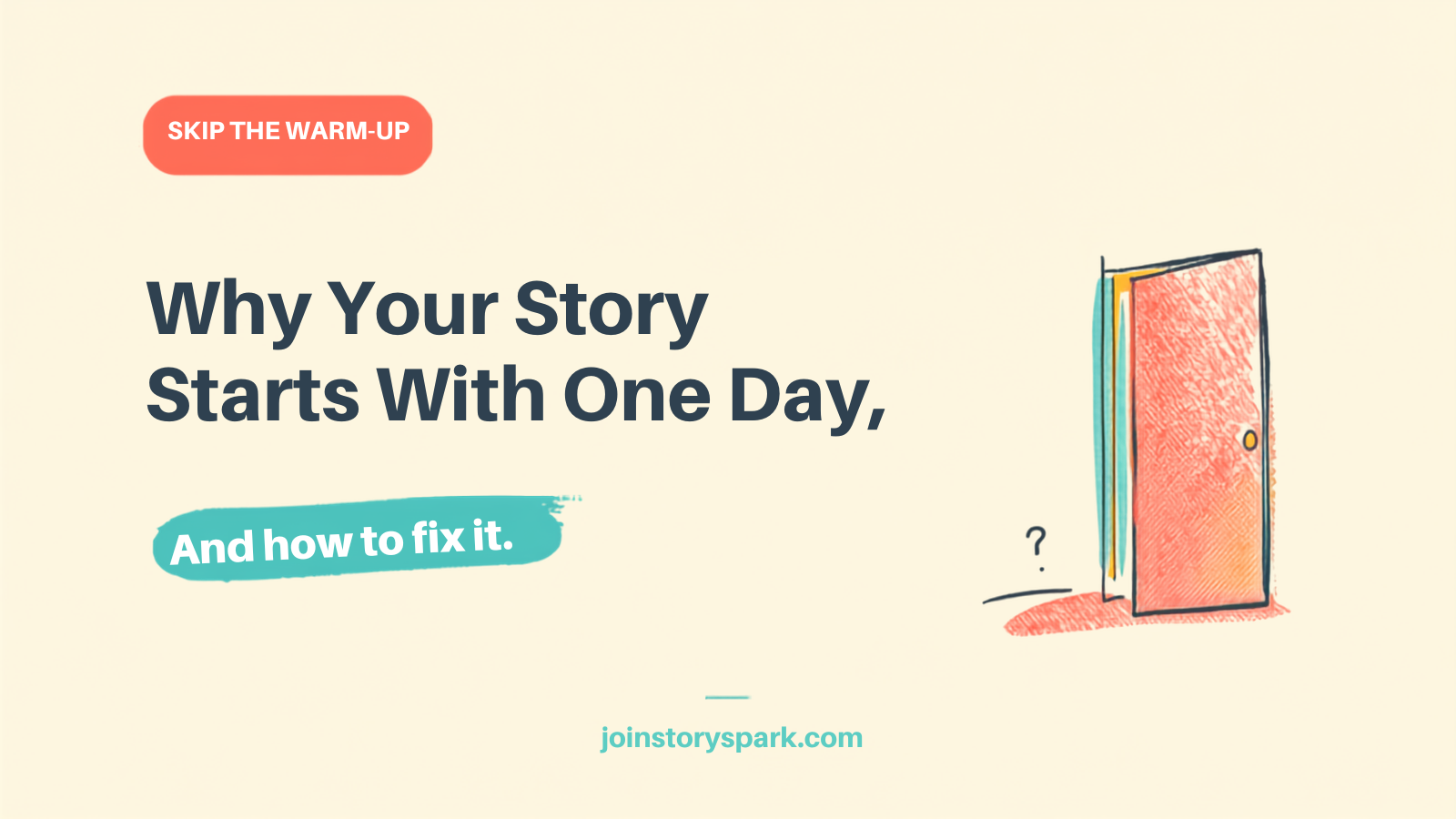
Why Your Kid's Story Starts With "One Day" (And How to Fix It)
Almost every story your kid hands you starts the same way: "One day..." or "Once upon a time..." It's not wrong, exactly — but it's the writing equivalent of clearing your throat before you actually say anything. The reader is still waiting for the story to start.
Openings are genuinely hard, even for adult writers. But there's a simple shift that helps kids skip the throat-clearing and land right in the middle of something happening.
"One Day" Is a Warm-Up, Not a Beginning
"One day" isn't a bad instinct — it's how a lot of oral storytelling starts, and kids pick it up naturally. The problem is that it delays the actual story by a sentence or two while the writer gets their bearings. It's a runway, not a takeoff.
Once a kid sees that, the fix isn't "never use one day" — it's noticing where the real story actually starts, and cutting straight to that point instead of walking up to it slowly.
Start With Something Already Happening
The strongest openings don't set the scene first — they drop the reader into a moment already in motion. Not "one day, a girl found a strange door," but "the door wouldn't stay shut, no matter how many times Mia closed it." The reader gets action and a hint of mystery in the very first line, instead of waiting for it.
This one shift — starting mid-action instead of before it — does more to fix a slow opening than almost any other single change.
A Great Opening Line Asks a Question Without Asking One
The best story openings make a reader wonder something, without ever spelling out the question. "The door wouldn't stay shut" makes a reader silently ask why not? That question is what pulls them into the next sentence — no cliffhanger tricks required, just one detail that doesn't quite add up yet.
Ask your kid: what's one weird, unexplained detail your story could open with? Almost any strange detail works, because strangeness itself creates curiosity.
Cut the Setup, Trust the Reader
Kids often think they need to explain everything before the story can start — who the character is, where they live, what a normal day looks like. Readers don't need that up front. They can learn who Mia is while she's already dealing with a door that won't stay shut.
This is a genuinely reassuring rule for young writers: readers are more patient with confusion than with boredom. A reader will forgive not knowing everything yet. They won't forgive nothing happening for three paragraphs.
A Simple First-Line Rewrite Exercise
Take a story your kid has already started with "one day" or "once upon a time," and try this: find the first moment something actually happens, and start there instead. Everything before that moment either gets cut or moves later in the story, where it can come out naturally.
This is a fast, low-pressure way to practice — no new story required, just a fresh first line on one that already exists.
Where StorySpark Helps With This Exact Skill
Finding the real starting point of a story is exactly the kind of craft question StorySpark is built to ask — the first story-writing trained AI agent, helping a kid notice where their story actually begins instead of where it warms up. It never writes the opening line for them. It just asks the question that helps them find the one their story already has.
A Strong First Line Changes Everything After It
A story that opens mid-action, with one strange unexplained detail, pulls a reader in before they've even decided to commit. "One day" isn't wrong — it's just usually one sentence too early. Finding the real beginning is often the single fastest improvement a young writer can make to any story.
Ready to help your child find the strongest way to start their story? StorySpark is the first story-writing trained AI agent — a built-in tutor that asks the right questions instead of writing the story for your child. Sign up and get started in seconds.