
The Six Skills Every Kid Writer Needs (And How to Teach Them Without Writing For Them)
Most tools built to "help" kids write a story fall into one of two traps. Either they write the story for the kid — a few clicks and a finished tale appears, with your child as a spectator to their own project — or they drown a beginner in grammar worksheets that have almost nothing to do with what makes a story good.
Neither one teaches a kid to actually write. And underneath both traps is the same missing piece: nobody's told your child what a story is actually made of.
Good writing isn't magic and it isn't just "creativity." It comes down to a specific, learnable set of skills. Once you know what they are, you can spot them, teach them, and watch your child get noticeably better — one story at a time.
Why "Just Write More" Isn't Enough
Practice helps, but practice without feedback just repeats the same habits. A kid who writes ten stories with vague description and flat dialogue doesn't automatically write an eleventh story that's better — they write a longer version of the same thing, unless something along the way points out what to work on.
That's the real job of teaching writing: not correcting commas, but naming the specific craft skill a story is missing, at the moment your child is ready to hear it.
The Six Dimensions of Narrative Craft
Every story — a picture book, a five-paragraph short story, a novel — can be broken down into the same six skills. This is the backbone of what StorySpark calls The Rubric, and it's a useful mental model even away from a screen:
1. Specificity — concrete, specific details instead of vague ones. "A dog" versus "a three-legged dog who only barked at mail trucks."
2. Voice — a story that sounds like a distinct person telling it, not a generic narrator.
3. Show vs. Tell — revealing emotion and character through action and detail, instead of stating it outright ("she was sad" vs. what sadness actually looks like).
4. Sentence Variety — mixing short, punchy sentences with longer, flowing ones so the writing has rhythm instead of a flat, repetitive beat.
5. Dialogue — conversation that sounds like real people talking, not a script.
6. Story Shape — the underlying structure that makes a story feel complete: a real beginning, rising stakes, and an ending that resolves something.
Individually, each is teachable in a five-minute conversation. Together, they're the difference between a story that's "fine" and one that's genuinely good.
Why Order and Timing Matter More Than the List Itself
Handing a kid all six of these at once is a fast way to overwhelm them — six things to think about is nobody's idea of fun, especially mid-story. The skill isn't memorizing the list. It's knowing which one dimension a specific story needs most, right now.
A story with vivid, specific detail but no real ending needs help with Story Shape, not another lecture on adjectives. A story with a strong plot but robotic dialogue needs focused, small practice on Dialogue — not five other things bolted on top. Good writing instruction is targeted, not exhaustive.
The Part Most Tools Get Wrong: Staying in the Driver's Seat
Here's the trap both extremes share: a tool that writes the story removes your child from the process entirely, and a worksheet that drills isolated rules removes the story entirely. Either way, the kid isn't the one making the decisions that matter.
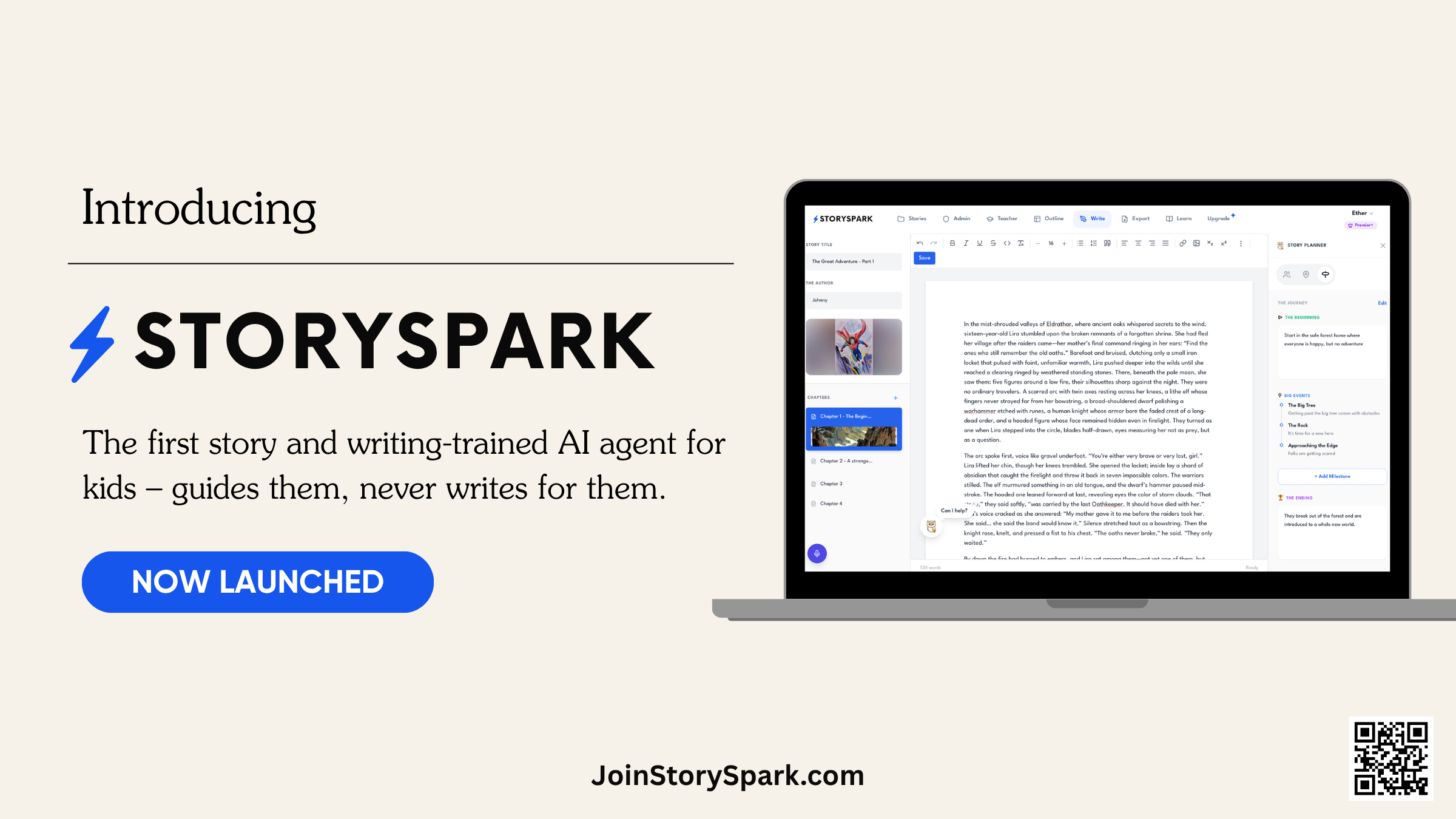
StorySpark was built around a different idea. It's the first writing-trained AI agent for kids — it guides, asks questions, and points toward the specific Rubric skill a story needs next, but it never writes the story for your child. Every sentence, every choice, still belongs to them. Spark's job is to keep them moving — engaged, learning, and progressing toward an actual finished story — without ever taking the pen out of their hand.
That distinction is the whole point. A child who finishes a story they wrote, with real guidance along the way, walks away as a better writer. A child who watched an AI generate one doesn't.
What "Adapting to Your Kid's Level" Actually Looks Like
A 7-year-old and a 13-year-old don't need the same feedback, even on the same Rubric dimension. Dialogue for a second grader might mean "does this sound like something a kid would actually say?" Dialogue for a middle schooler might mean noticing how two characters' speech patterns should differ from each other.
The right approach meets a child exactly where they are — not too easy to be boring, not so advanced it stalls them out — and adjusts as they improve. That's what keeps a young writer in a state of steady progress instead of frustration or boredom, which is usually the actual reason kids give up on a story before it's finished.
Ready to see what your child can write with the right guidance? StorySpark is easy to set up — sign up and start writing in seconds, with full access for your child's first month. No lectures, no writing-for-them shortcuts — just a story craft curriculum built to keep your kid in control, learning, and moving toward a story they actually finished themselves.