
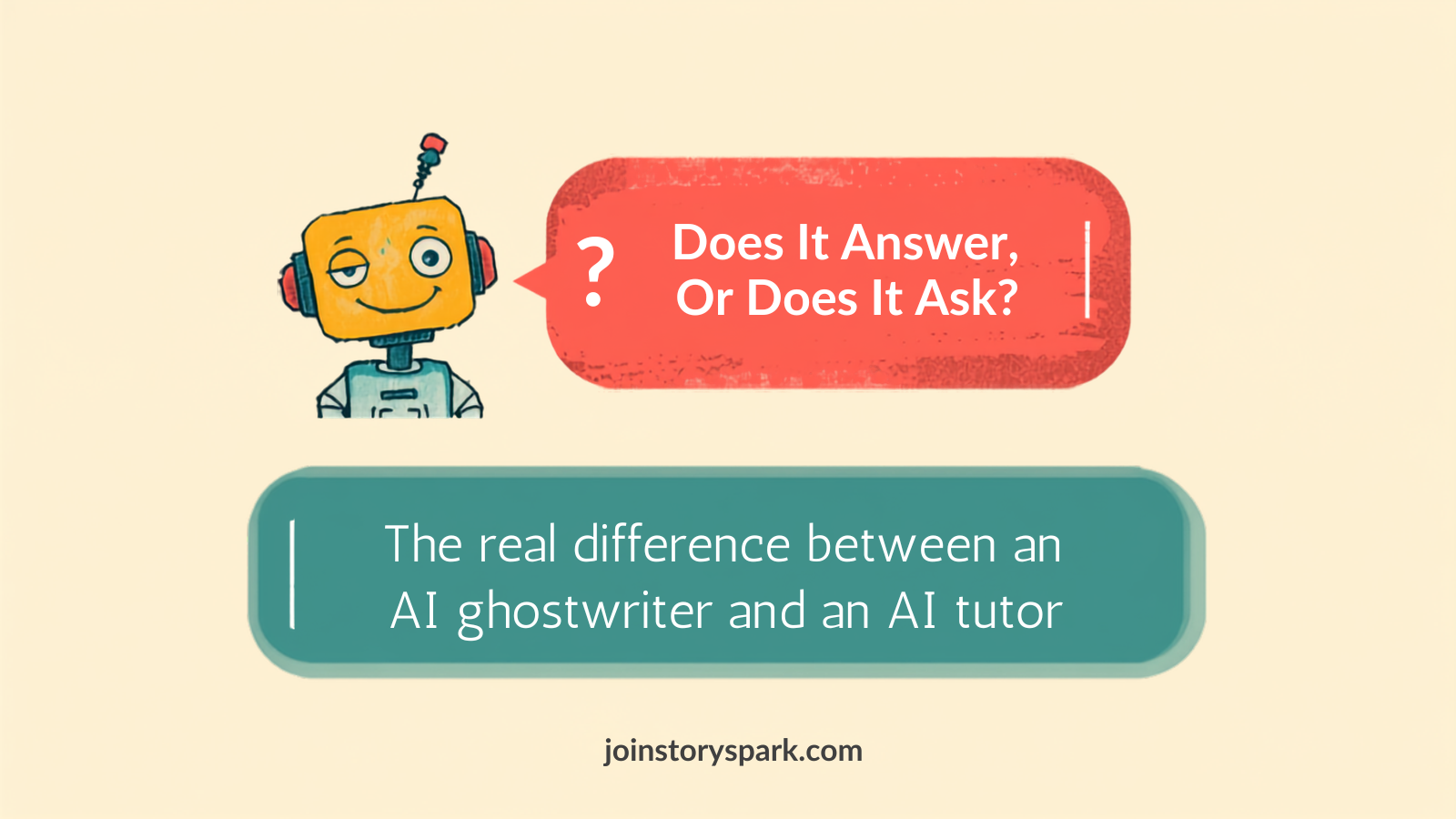
The Right Way to Use AI for Kids' Writing: Teach, Don't Write
Type "write a story about a dragon" into most AI tools and you'll get a finished story back in seconds — polished, complete, and entirely not your child's. It's tempting, especially on a busy night. But it teaches a kid nothing except that if you wait long enough, the story writes itself.
That's the real problem with how most people think about AI and kids' writing. The question was never "should AI be involved?" It's "what is the AI actually doing — writing the story, or teaching your child to write it themselves?"
Two Very Different Jobs
An AI that writes the story for a child is doing the child's job for them. An AI that teaches is doing something completely different: asking a question at the moment your child is stuck, the same way a good writing tutor would, then stepping back and letting your child answer it themselves.
The output looks similar from a distance — a finished piece of writing — but the process is nothing alike. One skips the learning. The other is the learning.
Why "Just Write It For Me" Feels Good and Teaches Nothing
It's easy to see why kids (and tired parents) reach for the version that just produces a finished story. It's fast, it's polished, and there's no risk of getting stuck. But a child who never gets stuck never learns what to do when they do get stuck — which is most of what writing actually is.
Every skill a kid needs — figuring out what happens next, noticing a scene needs more tension, realizing a character's reaction doesn't make sense — only gets built by wrestling with the problem, not by having it solved for them.
What a Real AI Tutor Actually Does
A tutor-style AI doesn't hand a child the next sentence. It asks the question that unlocks it. If a story stalls, it doesn't write what happens next — it asks "What does your character want right now, and what's stopping them?" If dialogue feels flat, it doesn't rewrite the line — it asks "What would this character actually say if they were nervous?"
This is the same technique a great human writing teacher uses: the goal was never to hand over the answer, it's to ask the question that gets a kid to find their own.
The "It Never Writes For Them" Test
Here's a simple way to tell which kind of AI tool you're looking at: ask what happens when your child gets stuck. If the answer is "the AI writes the next part," it's a ghostwriter. If the answer is "the AI asks a question to help your child figure out the next part," it's a tutor.
That one distinction is the entire difference between a tool that produces a story and a tool that builds a writer.
This Is Exactly What StorySpark Was Built to Do
StorySpark is the first story-writing-trained AI agent — built specifically to be a tutor, not a ghostwriter. When your child gets stuck, it asks the right question at the right moment, the same way a real writing teacher would, and it never writes the story for them. The story that comes out the other end is genuinely theirs — built with support, not built by something else wearing their name.
What to Look For as a Parent
When you're evaluating any AI writing tool for your child, ask one question: does it ask, or does it answer? A tool that always answers is doing your child's thinking for them. A tool that asks is doing exactly what a good tutor does — building the skill instead of skipping it.
Ready to give your child an AI that teaches instead of writes for them? StorySpark is the first story-writing-trained AI agent — a built-in tutor that asks the right questions instead of writing the story for your child. Sign up and get started in seconds.